
Mold Remediation Contractor in Santa Paula
Containment, Removal & Rebuild · Licensed & Insured · Lic. #1027281 · Since 1994
Mold in a Santa Paula house is almost never a cleaning problem. It is a moisture problem wearing a disguise, and in this town's older housing stock the moisture usually has a long head start: a slow leak in original pipe, a bathroom that never had an exhaust fan, a roof edge that has wept into a wall for years. Master Construction remediates the growth and, because we are a licensed and insured general contractor (Lic. #1027281), fixes the source and rebuilds the finishes under the same contract. The county practice lives on our water damage and mold page.
Where Mold Hides in This Housing Stock
Pre-war homes were built to breathe, and for decades they did. Then owners added insulation, sealed windows and closed up wall cavities, and the moisture that used to escape started condensing inside. Add the bathrooms that predate exhaust fans, the closets on uninsulated north walls, and the crawl spaces under raised foundations where a plumbing drip can run unseen for a season, and you have the standard Santa Paula mold map.
Hot, dry summers actually help this town; growth here is usually traceable to a specific water source rather than ambient humidity. That is good news, because a source you can find is a source you can fix. Every job starts with that hunt: moisture meters through the assembly, a crawl under the house if it has one, and a look at the plumbing and roof history before anyone opens a wall. Remediation without source repair is a subscription, and we do not sell those.
Crawl spaces deserve special mention. Raised foundations keep these houses breathing, but a disconnected dryer duct, a leaking hose bib or years of poor drainage can turn the space under the floor into a humidity engine feeding growth in the rooms above. We crawl it, photograph it and correct the conditions, vapor barrier, grading, ventilation, as part of the remediation rather than leaving the engine running beneath a cleaned house.
Containment First, Then Removal Done Properly
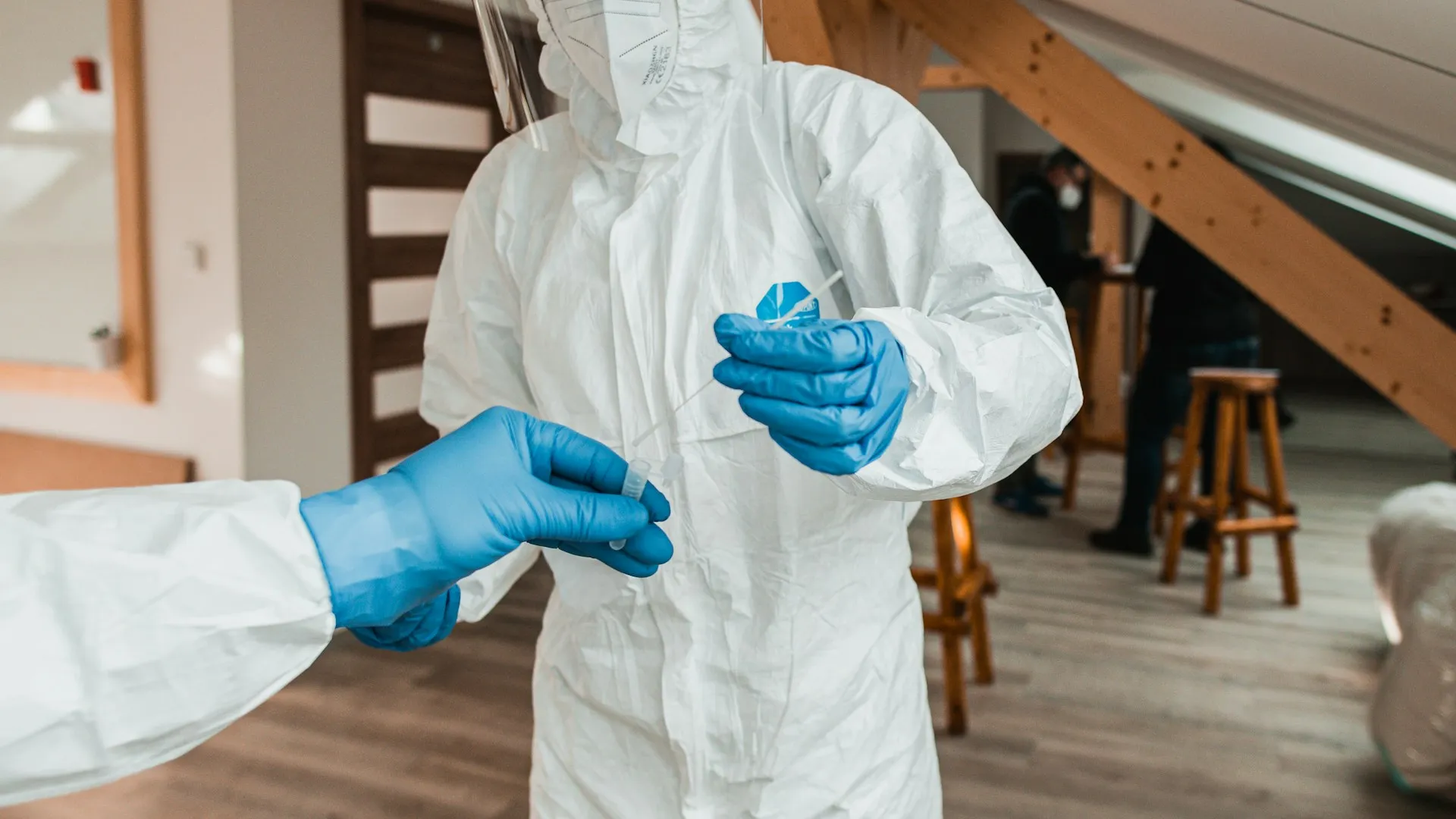
The cardinal sin of mold work is spreading spores through a house on the way to removing them. Affected rooms get sealed under plastic containment with negative air machines exhausting through HEPA filtration before any demolition starts. Crews work in protective gear, contaminated material leaves in sealed bags, and porous materials past saving, drywall, insulation, carpet pad, are removed rather than treated and wished well.
Plaster earns a more careful call than drywall. Sound plaster with surface growth can often be cleaned, treated and saved, which matters in a Victorian where ripping walls means losing original fabric. Framing gets cleaned, HEPA-vacuumed and treated; a century of old-growth lumber is tougher than the mold on it. Where jobs are substantial, we recommend independent third-party clearance testing before rebuild, so the all-clear comes from someone with no stake in the answer. Then our own crews close the walls: drywall and plaster repair, texture matching, trim and paint, with new exhaust ventilation installed where the old bathroom never had any.
Rentals, Disclosure and Doing This by the Book
A large share of our Santa Paula mold calls come from rental housing, where the stakes are legal as well as structural. California requires landlords to address known mold conditions, and tenant complaints escalate quickly when responses look casual. Property managers get from us a fast inspection, findings in writing with photos, a remediation plan with containment appropriate to an occupied building, and completion documentation for the unit file. That paper trail protects owner and tenant alike.
Multi-generational households ask a different question: is it safe to stay during the work? Usually yes, because containment isolates the work area, and we sequence rooms so the household keeps functioning. We are plain about the exceptions.
HOA boards bring us the disputes, growth at a shared wall or below a common roof, and get the same evidence-first treatment: document the moisture path, report in writing, remediate once responsibility is clear. Where the rebuild involves structural or system repairs, permits run through the City of Santa Paula's building department and we handle them as part of the scope.
Mold Remediation Services in Santa Paula
- Moisture source investigation & repair
- Plastic containment & negative air
- HEPA-filtered removal & cleanup
- Plaster-saving surface remediation
- Crawl space & subfloor treatment
- Bathroom ventilation retrofits
- Independent clearance testing coordination
- Full rebuild: drywall, texture, trim, paint
- Landlord documentation packages
- Occupied-home & tenant-safe scheduling
FAQ
Santa Paula Mold Remediation - FAQ
I found a dark patch on a bedroom wall. Is it mold?
Possibly, and the wall is telling you something either way. Dark staining on a north wall or closet usually means condensation; a spreading patch near a bathroom or under a window usually means a leak. We inspect with moisture meters and give you a finding, not a scare.
Can I just bleach it and repaint?
On a small patch of hard surface with no moisture source, cleaning can be reasonable. But bleach on porous drywall or plaster kills the surface and leaves roots, and paint over an active source guarantees a return engagement. If it keeps coming back, the wall needs opening, not another coat.
Will you have to tear out my plaster walls?
Not automatically. Sound plaster with surface growth can often be cleaned and saved, which we prefer in historic homes. What is always removed is saturated porous material: soaked drywall, wet insulation, ruined carpet pad. The decision is made wall by wall with a meter, not by rule of thumb.
Is mold work disruptive for the rest of the house?
Less than people expect. Containment seals the work area completely, negative air keeps spores from migrating, and the rest of the house stays livable in most residential jobs. We sequence multi-room projects so bathrooms and kitchens are never all offline at once.
How do I know the mold is actually gone when you finish?
On substantial jobs we recommend clearance testing by an independent hygienist before the walls close, so the verification comes from a third party. You also get photos of the opened, cleaned assembly. Rebuild starts only after the cavity is verified dry and clean.
Why did my bathroom start growing mold after new windows went in?
Because the house got tighter. Old single-pane windows leaked air and carried moisture out; sealed replacements keep it inside, and a bathroom with no exhaust fan has nowhere to send steam. The fix is ventilation, which we retrofit ducted to the exterior, not into the attic.
What does a property manager get from you on a mold complaint?
Speed and paper. Inspection within days, written findings with photos the owner can act on, remediation with containment suited to occupied buildings, and close-out documentation for the tenant file. Handled that way, most complaints end as maintenance items instead of disputes.
Related Services
Mold work connects to water damage restoration in Santa Paula, bathroom remodels, and painting. County-wide details: restoration services. All local work: Santa Paula.
Inquiries
Something Growing That Shouldn't Be?
Call (805) 667-8800 for an inspection with a moisture meter and a written answer.